



Essential route through the white villages of Malaga
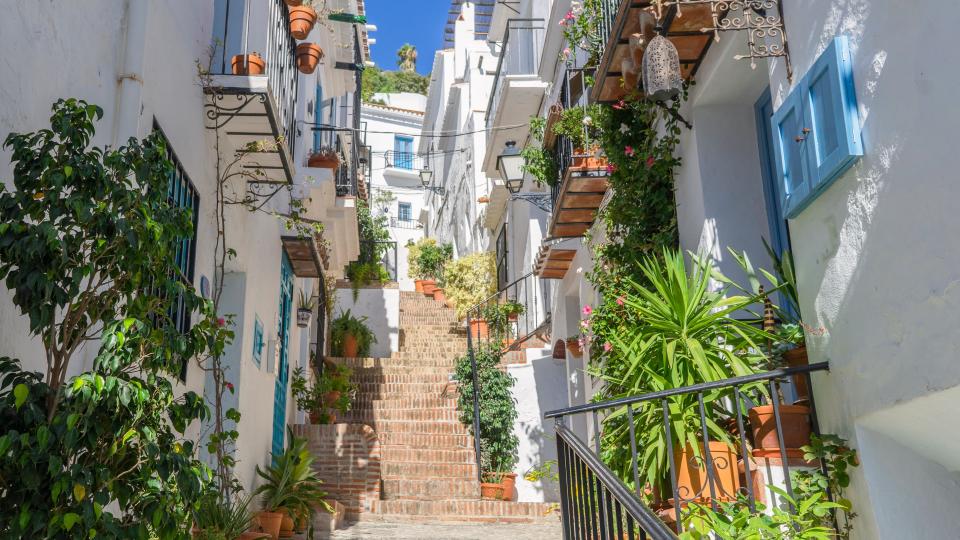
The towns in the area around the Serranía de Ronda and Axarquía mountains have a unique identity. With an extraordinary location in some of the most beautiful natural enclaves in Andalusia, and architecture that has managed to preserve the essence of tradition, the white villages of Málaga are a must-see destination for anyone wishing to discover the history and landscape of the province.
5 must-see stops in the white villages near Malaga
Within an hour's drive of Malaga, these are the most popular white villages:
Mijas
A mountain village with extraordinary views of the Mediterranean. It stands out for its whitewashed houses nestled among labyrinthine streets decorated with blue flowerpots and for its popular donkey taxis that take tourists on tours around the village.
Casabermeja
It is located in the Montes de Málaga mountains, although it belongs to the Antequera region. It is a highly recommended place to learn about the history of the area, with notable sites such as the San Sebastián Cemetery, declared a National Monument for its unique architecture, the Zambra Tower and its wonderful panoramic views, and the Peñas Cabrera archaeological site, with examples of prehistoric rock art.
Ojén
Its location in the natural enclave of the Sierra de las Nieves, very close to Marbella, makes the whitewashed houses of Ojén seem to rush down the hillside like a white stain. Apart from monuments such as the Church of Nuestra Señora de la Encarnación and the Fuente de los Chorros fountain, the village is famous for its Castillo del Cante Flamenco Festival and Ojeando Festival, dedicated to independent rock music.
Filigrana
It is one of the most popular destinations among the white villages of Malaga, and often appears on lists of the most beautiful villages in Spain. The architectural heritage of its Moorish past, the romanticism that permeates its cobbled streets, and its photogenic facades with balconies and flowers contribute to the creation of a genuine Andalusian atmosphere.
Casares
Declared a Historic-Artistic Monument, this village boasts that it takes its name from Julius Caesar himself, who apparently came here to be cured of a skin condition at the Baños de la Hedionda baths, which can still be visited today. Apart from this spot with its sulfurous waters, the village stands out for its ‘hanging’ location, its labyrinthine center with Arab influences, and the views from the ruins of its medieval fortress.
With a little more time, the route through the white villages of Malaga can be extended northwards (to places such as Ronda or Benaoján) or westwards, extending into the province of Cadiz (towards Jimena and Castelar de la Frontera).
Tips for a tour of the white villages of Malaga
- Plan a route that fits the time you have available. Although the distances are not excessively long, we recommend between 3 and 4 days for this short route, and around 7-10 days for a more extensive visit to Ronda or the Sierra de Grazalema, in the province of Cádiz. A car is essential.
- Although the route can be done at any time of year, the spring months are the most recommended. Between April and June, temperatures are moderate and the afternoons are longer, allowing you to make the most of the day.
- The route through the white villages of Malaga is also a gastronomic experience where you can sample popular dishes such as suckling goat, porra antequerana (a cold soup), migas (fried breadcrumbs) and ajoblanco (a cold almond soup).